Friday, May 03, 2024

Academic Freedom Doesn't Mean Tech Chaos

Technology Chaos


The principle of academic freedom is a vital one that allows college and university professors to teach controversial subjects and voice unpopular opinions without risk of institutional sanction. It is also a cherished principle that empowers faculty members to pursue knowledge, research, and teaching without undue interference or censorship. However, the concept is often misinterpreted by faculty to extend far beyond its intended scope into the realm of technology choices. Some professors assert that academic freedom gives them the right to reject their college's officially supported learning management system (LMS) and other educational technology tools in favor of using entirely disconnected, unsupported and redundant third-party applications and services.

This pseudo-libertarian stance on institutional technologies often creates chaos and inefficiencies for students, faculty, IT support staff, and administrators alike, often unnoticed by the instructor causing the issues. When professors stray from the college's unified digital ecosystem, students get a fragmented experience bouncing between different tools for each class. Providing IT support across these dispersed technologies is a nightmare, and leaves students seeking help with a rogue software tool out in the cold. I have known of students dropping classes, and experiencing anxiety over losing financial aid because their instructor has implemented an unsupported technology, and can't or won't offer support for it! Also, colleges lose out on economies of scale by being unable to standardize on a core set of integrated platforms.

Academic freedom absolutely allows professors freedom in how they construct curriculum, manage classroom discussions, and express ideas - even controversial ones. But it doesn't give faculty carte blanche to arbitrarily ignore established institutional technologies and processes. After all, professors don't have the "academic freedom" to stop submitting grades or stop holding class sessions on the authorized schedule and location.  

So what can college leaders do to realign faculty behaviors with the true definition of academic freedom? A few key action points:

  • Have a clear, unambiguous acceptable use policy that circumscribes academic freedom to matters of curriculum and classroom instruction - not institutional needs and requirements such as adhering to the authorized and supported Learning Management System.
  • Ensure the LMS and approved ed tech tools have rich functional versatility so faculty don't feel constrained. The technology itself should support diverse pedagogical approaches and student learning needs.
  • Provide initial and ongoing training and support by offering comprehensive training sessions, workshops, and resources to familiarize faculty with supported technologies and demonstrate their potential benefits for teaching and learning. Additionally, establish channels for ongoing technical support and troubleshooting to address faculty concerns and promote confidence in utilizing institutional platforms. College employees who are required to use a given technology to earn their paychecks should also be paid to attend training on those tools. Training doesn't cost, it pays.
  • Involve faculty governance bodies in the process of evaluating and selecting core technologies. This will build more buy-in.  
  • Highlight costs and risks of ad hoc technology adoptions - security vulnerabilities, missed ops/procurement discounts, support staffing sprawl, etc.
  • Engage faculty and student support personnel in the conversations and decisions. They make their living working hands-on with a variety of educational technology tools, and quite often have experiences and insights nobody else on campus has. Also, they are the ones faculty and students will be turning to for troubleshooting and ideas on how to use the technologies effectively and efficiently. This will build even more buy-in.
  • Facilitate cross-departmental collaboration. Foster interdisciplinary collaboration and knowledge-sharing among faculty members, support staff, coaches, advisors, student help desk personnel, etc. to explore innovative uses of technology across academic disciplines. Encourage the formation of communities of practice focused on leveraging technology to address shared challenges and enhance the overall quality of teaching and learning experiences.
  • Survey students regularly on their technology experience and usage to identify rogue tools. Share this data with IT leadership and faculty as a prompt for change.
  • Celebrate and provide high visibility to "model" faculty who are creatively using institutional technologies in innovative ways while respecting policy.

Ultimately, college and university faculty need to understand that a cohesive, standardized technology architecture benefits everyone - including themselves through easier training, support and collaboration. Ad hoc tech fragmentation becomes its own pernicious form of chaos, inhibiting the very academic freedom it purports to protect.

With pragmatic policies, economically smart tech selection processes, faculty and support personnel input mechanisms and consistent leadership communication, colleges can realign the academic freedom principle with its original intent. The credibility, effectiveness, reputation, and sustainability of the institution depends on it.

On LinkedIn

Tuesday, February 20, 2024

Introducing the Hole-In-The-Wall Cafes Google Maps List

I stumbled into a Facebook group recently called Hole-In-The-Wall Cafes where members can post about their favorite hole-in-the-wall cafés and diners. No franchises allowed, and the same goes for bars, saloons, taverns, etc. If a restaurant happens to serve adult beverages, that's cool, but it's supposed to be more about good food than primarily a drinking establishment. I got to thinking about how people might find it useful to have all of those locations on their mobile devices as they travel, along with an app that most people either already have or can get easily, and, of course, Google Maps came to mind. I reached out to the Facebook group owner, and we have collaborated on this awesome new list to which we will be adding locations from member posts and elsewhere. Here is a direct link to the list. Be sure to save and share it!

Save and share


Thursday, February 15, 2024

Dad Is A Badass

My 23-year-old son called me when I was leading a group ride along this road between Steens Mountain and the Alvord Desert in southeast Oregon. I answered the call through my helmet comm, and immediately told him to look up "Alvord Desert" in Google Maps. He asked if that was where I was, and I said, "yep, that's where I'm at, and I'm riding at 80mph, standing up on my pegs, enjoying the breeze." When he didn't answer, I asked if he was still there, and he said, "yeah, Dad, I'm just getting my head around that. Dad, you are such a BADASS!


Tuesday, January 30, 2024

Google Maps Route to GPX File

 This screencast video is all about how to create a GPX file from a Google Maps route you have created. Trying to use Google maps on a trip where you may go in and out of cell coverage is risky, because if and when you flip away from the Google maps app to another app on your mobile device, and come back, you risk losing the route out there, which, of course would be a bad thing in the middle of nowhere. This process shows you how to lock down your route on a GPS receiver or GPS app so it doesn't matter if you go in and out of cell coverage. This method is admittedly not the simplest method available, but it is one that opens the door for additional features you may get into once you step into the wonderful rabbit hole of GPS and GPX file manipulation. Enjoy!

Tuesday, January 16, 2024

The Lone Wolf or the Pack: Adventure Motorcycle Group Trips vs Solo

As an avid adventure motorcyclist who loves exploring backroads and discovering new places and vistas, I often deliberate the question: Should I join a multi-day group ride or strike out on a solo journey? Both options provide immense satisfaction, freedom, and sights that renew my soul. However, group expeditions and solitary sojourns each offer unique perks that merit consideration.

Hitting the road with a group of fellow riders builds camaraderie and support unmatched on solo trips. Long days in the saddle can be grueling, but good company makes the miles fly by faster. Groups also afford more flexibility should issues arise - if your bike breaks down, there's likely another rider who can help or shuttle you into town. Plus, sharing costs for hotels, fuel, or other expenses can ease budget constraints. However, group dynamics aren't always harmonious, and ill-matched speeds, riding styles, or personalities can dampen the mood. And you lose autonomy over daily routes, pace, and overnight stops when others’ preferences differ from yours.

Conversely, solo adventures enable following your own whims wherever the compass leads without compromise. I alone choose whether to rise early to chase sunrise vistas or sleep in if heavy rains fall. I set my pace foraging backroads rather than worrying about trailing or leading riders if I’m quicker or slower that day. Stopping for photos, snacks, or simply to soak in an overlook’s ambience isn’t problematic without antsy cohorts impatiently waiting. The stillness and self-reliance of solo travel builds confidence and serenity. Yet the utter solitude also leaves little margin for mechanical problems or minor crashes without backup support. 

Ultimately, sharing the open road and a cold beer at day’s end with like-minded riders creates bonds difficult to replicate solo. But escaping regularly into the wilderness alone fosters self-trust and inner tranquility. Thus the best path forward, in my eyes, lies in balancing group trips that nourish the soul through friendship with frequent lone adventures to renew my personal reservoirs of resilience and confidence. With this dual fellowship-and-solitude approach, adventure motorcycling shall continue fulfilling my yearning for the open road for years ahead!

Coming Soon: Ancient Knowledge & Wisdom

We are on the verge of being able to read scrolls that were buried and charred in the eruption of Mount Vesuvius in 79 AD. A collection of 1,800 scrolls were discovered in an ancient Roman villa near Pompeii during excavations in the 18th century. However, attempting to unroll and read these fragile scrolls has proven extremely difficult over the years.

Recently, researchers have been using a new X-ray technique called “phase-contrast tomography” to virtually unroll and decipher the scrolls. This allows them to see inside the scrolls and read the ancient Greek and Latin texts without physically unrolling them. So far they have had success reading a few scrolls, including one discussing the Greek philosopher Epicurus.

The researchers believe there may still be hundreds of scrolls that could provide insight into ancient philosophical thinking and day-to-day life during that period. However, the scrolls are very delicate and the technology is still in early stages. The work requires scanning the individual scrolls in very small pieces. Nonetheless, this work marks an exciting advancement in reading these long-lost ancient texts.

“Scholars have long faced a choice between attempting to read concealed texts (and potentially destroying them in the process) or conserving them unread. Brent Seales’ technology is removing that dilemma.”

It is a long read, but well worth it.

Wednesday, January 03, 2024

The Nightmare of a Stolen Motorcycle Helmet

You're out for a long motorcycle road trip, enjoying the freedom of the open road. You stop to take a break, park your bike, and take off your helmet to get some air. Then when you turn around - it's gone. Some opportunistic thief has snatched your helmet and now you're stuck. No helmet means you can't legally or safely continue your ride. It's every motorcyclist's nightmare scenario.

If you find yourself helmetless and stranded, don't panic. While hugely inconvenient, the situation is manageable if you keep a cool head. Follow this advice on how to deal with a stolen lid when traveling far from the comforts of home.

File a Police Report

The very first thing you should do is notify the local police that your helmet was stolen. Provide them details on where it happened, the make/model of the missing gear, and anything noteworthy about its looks. Getting an official report created starts a paper trail in recovering or replacing your equipment. It also alerts cops to a theft that may aid other riders in the area.

Check Area Businesses For Security Footage

Canvass nearby buildings, gas stations, shops, etc to ask if security cameras potentially caught footage of the culprit. Seeing the incident on video can assist police in catching the criminal. Review tapes yourself for any identifying details. Be sure to get copies of useful recordings.

Inform Your Insurance Provider

If the helmet was insured under homeowners, renters or motorcycle-specific policies, start the claim process right away. Provide all details needed and the police report case number. See what compensation your insurer provides for stolen riding gear - it may help pay for a replacement. Just don't expect coverage equal to the helmet's original value.  

Ask Social Media For Sightings

Post on regional riding groups and forums on sites like Facebook asking fellow riders to keep an eye out for your lid. Share the make, model, graphics and any custom details to identify it. Also watch resale sites like Craigslist and eBay yourself in case the thief tries selling it online. Getting the word out to the motorcycle community taps into a huge network of eyes.

Replace Your Helmet ASAP

While insurance and police investigations proceed, your top priority needs to be replacing your helmet so you can safely ride. Find the nearest motorcycle gear shop to buy a new lid. Getting the exact same helmet would be ideal so you don't need to re-break-in an unused model. Choose the most comparable one if your previous brand/type is unavailable in the area. Don't ride without head protection - it poses substantial injury risks.

Consider a Helmet Locking Device

Once you're equipped with a new helmet, invest in a helmet lock to deter future thefts. Companies like Bandit offer rear wheel locks that attach to your helmet's D-rings with thick steel cable. This secures your lid under the bike seat or to saddlebags while stopped. Though not foolproof, it keeps opportunists from grabbing unsecured gear. Prevent the headache upfront.

Remain Vigilant On The Road

While continuing your travels, keep an eagle eye on your helmet anytime you park. Take it with you when going inside businesses rather than leaving it on the bike. Never let it out of your sight. Report suspicious activity near motorcycles. Caution and attentiveness will help avoid yet another stolen lid incident.  

Getting your helmet stolen away from home is hugely disruptive to your ride. But following these tips helps get you back on the open highway safely. Ride prepared for anything by insuring gear, locking helmets, and staying aware so your two-wheeled adventures won't get derailed again!

Wednesday, April 05, 2023

Ask ChatGPT: Which LMS is better: Moodle or Canvas?

Via the Perplexity app

Moodle and Canvas are two popular learning management systems (LMS) used in educational institutions. Both platforms have their strengths and weaknesses, and the choice between them will depend on the specific needs and requirements of the institution or organization.

One of the main advantages of Moodle over Canvas is its flexibility. Moodle is an open-source LMS, which means that it can be customized and modified to meet the specific needs of an institution or organization. Moodle supports more than 12 types of assessments, and there are multiple grading alternatives available to grade different assessments in different ways. Moodle also has an optional, fully-branded mobile app. However, Moodle has limited support, and organizations will need to contact their Moodle partner for additional support.

In contrast, Canvas is a closed-source LMS, providing fewer opportunities for customization. Canvas is equipped with various in-built features, but it is less adaptable than Moodle when it comes to personalizing the platform. Canvas LMS offers more robust collaboration features, and it has more robust support than Moodle. However, Canvas can be more expensive than some other LMS platforms, while Moodle is free to use as it is an open-source platform.

Ultimately, the best LMS platform for an institution or organization is the one that meets its specific needs in the most effective way, regardless of cost.

Friday, March 31, 2023

Downloading Student Assignment Submissions in Your Moodle Course

Here is how to download all of the student submissions in each Assignment activity in your Moodle course, and then efficiently upload them into your Google drive.


Just Say No to Vehicle Gun Holsters

My response when someone in a vehicle group I am in made a post asking for recommendations for a vehicle-mounted handgun holster system:


Sunday, March 26, 2023

North Fork Bridge Banded Gneiss

Walk down the trail from the northwest corner of the bridge over the North Fork of the American River in Northern California, continue along the river for a short distance, and you will be rewarded with some large boulders consisting of Banded Gneiss rock, showing amazing multi-colored stripes along their length. Do some research on this rock type before your visit, so you understand and appreciate this breathtaking natural art! When I first stumbled upon these rocks, I was so struck by the unexpected natural beauty that my automatic reaction was to tear up in wonder and appreciation. I think you might have the same memorable experience. Enjoy!

Google Maps location


Sunday, May 16, 2021

The Hard to Swallow Pill About City Dwellers

My good friend Jason Smith wrote this, and I am sharing it here with his permission.

Hard to swallow pill:

Any weak person can exist in a city. That’s why cities are generally the liberal concentrations of any given state. People not strong enough to live by their own means, flock to the safety, and welfare culture of those socialist landscapes. 

Things are easy. A store on every corner, call for a car, call for food, call for an ambulance, call for the police. Ride a train, a subway, city bus, a shuttle bus, or walk a few blocks. Live in a politically active city, and the government comes to your door offering money, food, shelter; need a phone? Here you go, we take care of you; don’t forget to vote democrat. 

No, I’m serious. Weaker people are generally concentrated in urban areas. Those that cannot survive on their own, those that need the safety net of a thousand politicians and programs. 

Those city dwellers are brought up in an environment that encourages them to believe that they are the enlightened ones, and that rural citizens are their lesser. 

Well, here’s the deal, any rural person could move to the city and thrive, but can we say the same for an urbanite suddenly “on their own” somewhere in rural America? 

Can the IT specialist, sipping his latte, if dropped into the wilderness, suddenly summon the skills needed to survive completely on his own? 

Drop me off naked in the wilderness, and when you come back in a year, I’ll invite you into my warm cabin for a nice salad, baked potato, a steak, and a glass of whiskey afterward; on the rocks if you wish? I could put on a peach cobbler for later if you’d like?

How many urban dwellers know how to feed their family without a store? Get water without a faucet? Provide shelter for their family without a contractor and construction crew? What if threatened with physical violence, and 911 isn’t an option? 

Most of what an urbanite “knows” about the real world, wouldn’t be available to them without electricity and WiFi; and that’s a fact. 

Cities get their food from rural areas, their fuel from rural areas, their lumber, hell; everything. 

But what do rural people get from the cities? More taxes? More infringing laws? Residual crime waves? What? 

Never forget who needs who. Urbanites need rural America to survive, while rural America would actually thrive without the drains of the urban liabilities. 

But what do I know, I’m just a guy from a little ag town.

Monday, April 26, 2021

Malheur Cave

This is a video showing Maheur Cave, owned by the Freemasons that I visited in August 2020. A group of Masons were replacing the bleachers with some nicer aluminum ones they had "acquired" from an undisclosed high school. They said they were preparing for a special secret ceremony the following month.


Thursday, April 01, 2021

Bumper Installation Instructions

The guy who made my Tacoma bumper asked if anyone would be interested in writing installation instructions, since that’s not his thing.


Thursday, January 14, 2021

Appointment Slots in Google Calendar

Wouldn't it be great if you could send out, or publish a link that people could click, and be taken to a view of your calendar, where they could see available appointment slots, and all they had to do to make an appointment with you is click an available slot, and then the event appears on both your and their calendar? Welcome to Appointment Slots!


1. Important: Make sure you are in Week or Day view. Click into any date/time area on your Google Calendar, and a popup will appear. 
Click "Appointment slots" at the top of the popup, and then "Edit details" at the bottom:


2. This is where you will do all (and it's not much) of the heavy lifting:


3. Make sure you put something into the "Title" field that will make sense to both you and your end user. For example, if you are setting up advising appointments with students, rather than "Appointment," consider "Advising Appointment."

4. You are likely using Appointment Slots in a repeating fashion. If so, click the "Does not repeat…" checkbox (I usually need to choose "Custom…":


I set this series of Appointment Slots to repeat weekly on Mondays and Wednesdays until the end of the term:


Also be sure to indicate a meeting duration time, and a meeting location in the "Add location" field.

5. Consider something like this in the "Description" field:

Bring your education plan, degree audit documents from DegreeRunner (if you have access) and/or any documents pertaining to your college course of study.

6. Right-click and copy the long, blue URL:


That's what you can send to your students and/or place in your Moodle course and/or email message, etc.

NOTE: The Appointment Slot URL is the URL for ALL appointment slots for the Google Calendar in which you are creating the appointment slot. If you need/want a unique URL, make a different calendar for that.


7. Click the blue "SAVE" button in the upper left:


Here is what it looks like when I access someone else's Appointment slots link:


Check out all of those appointment slots - I can seem them in context with my other appointments!

When someone clicks to reserve a time slot with you, here is what they will see:


Note that they can customize the details of the event after they save it.

Pretty nifty, huh? I think you've got enough to go on, so go ahead and tinker with your own Appointment Slots. And share your impressions and experience in the comments section below!

Thursday, December 03, 2020

GPS Routing Vs. Tracking

A dear friend sent this screenshot to me.


It is important to understand the difference between using GPS to ASSIST with navigation, but not TAKE OVER your navigation. I almost never use routing (and NEVER in the backcountry), but rather stay on the map screen to keep my planned track visible. Then I make my own routing decisions based on what the roads, trails, terrain, and general risk potential looks like. If I need to deviate from the route I originally had in mind, it is because I made the decision, not a set of algorithms computing and plotting my route for me from thousands of miles away from the real-life situation I am in. I have had countless times when this approach has worked well for me, when a GPS routing technique may well have ended in disaster.

If you don't understand the difference between GPS routing and tracking, I would be happy to help with that. That knowledge could actually save your life.

Thursday, November 05, 2020

Let's Focus On Our Commonalities

For every person who feels the last 4 years have been a shit show, there is one person who believes the same will come with Biden. The powers-that-be have us in constant turmoil and angst toward each other, and we had better start focusing on what we have in common, rather than picking and poking at our differences.

Thursday, August 22, 2019

Normalizing Fascists

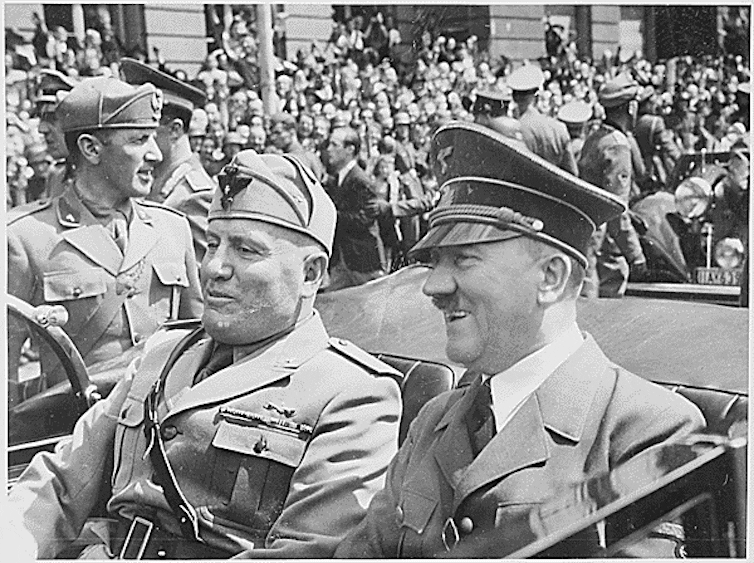
Benito Mussolini and Adolf Hitler in Munich, Germany. National Archives Collection of Foreign Records Seized, 1675 - 1958
John Broich, Case Western Reserve University
How to report on a fascist?
How to cover the rise of a political leader who’s left a paper trail of anti-constitutionalism, racism and the encouragement of violence? Does the press take the position that its subject acts outside the norms of society? Or does it take the position that someone who wins a fair election is by definition “normal,” because his leadership reflects the will of the people?
These are the questions that confronted the U.S. press after the ascendance of fascist leaders in Italy and Germany in the 1920s and 1930s.

A leader for life

Benito Mussolini secured Italy’s premiership by marching on Rome with 30,000 blackshirts in 1922. By 1925 he had declared himself leader for life. While this hardly reflected American values, Mussolini was a darling of the American press, appearing in at least 150 articles from 1925-1932, most neutral, bemused or positive in tone.

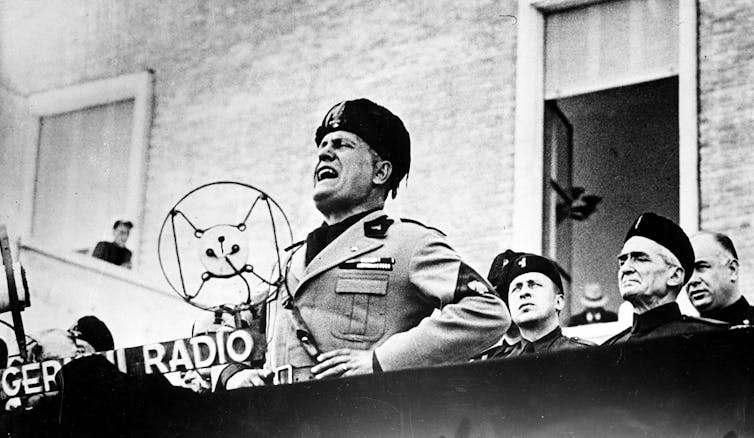
Benito Mussolini speaks at the dedication ceremonies of Sabaudia on Sept. 24, 1934. AP Photo

The Saturday Evening Post even serialized Il Duce’s autobiography in 1928. Acknowledging that the new “Fascisti movement” was a bit “rough in its methods,” papers ranging from the New York Tribune to the Cleveland Plain Dealer to the Chicago Tribune credited it with saving Italy from the far left and revitalizing its economy. From their perspective, the post-WWI surge of anti-capitalism in Europe was a vastly worse threat than Fascism.
Ironically, while the media acknowledged that Fascism was a new “experiment,” papers like The New York Times commonly credited it with returning turbulent Italy to what it called “normalcy.”
Yet some journalists like Hemingway and journals like the New Yorker rejected the normalization of anti-democratic Mussolini. John Gunther of Harper’s, meanwhile, wrote a razor-sharp account of Mussolini’s masterful manipulation of a U.S. press that couldn’t resist him.

The ‘German Mussolini’

Mussolini’s success in Italy normalized Hitler’s success in the eyes of the American press who, in the late 1920s and early 1930s, routinely called him “the German Mussolini.” Given Mussolini’s positive press reception in that period, it was a good place from which to start. Hitler also had the advantage that his Nazi party enjoyed stunning leaps at the polls from the mid ‘20’s to early ‘30’s, going from a fringe party to winning a dominant share of parliamentary seats in free elections in 1932.
But the main way that the press defanged Hitler was by portraying him as something of a joke. He was a “nonsensical” screecher of “wild words” whose appearance, according to Newsweek, “suggests Charlie Chaplin.” His “countenance is a caricature.” He was as “voluble” as he was “insecure,” stated Cosmopolitan.
When Hitler’s party won influence in Parliament, and even after he was made chancellor of Germany in 1933 – about a year and a half before seizing dictatorial power – many American press outlets judged that he would either be outplayed by more traditional politicians or that he would have to become more moderate. Sure, he had a following, but his followers were “impressionable voters” duped by “radical doctrines and quack remedies,” claimed the Washington Post. Now that Hitler actually had to operate within a government the “sober” politicians would “submerge” this movement, according to The New York Times and Christian Science Monitor. A “keen sense of dramatic instinct” was not enough. When it came to time to govern, his lack of “gravity” and “profundity of thought” would be exposed.
In fact, The New York Times wrote after Hitler’s appointment to the chancellorship that success would only “let him expose to the German public his own futility.” Journalists wondered whether Hitler now regretted leaving the rally for the cabinet meeting, where he would have to assume some responsibility.
Yes, the American press tended to condemn Hitler’s well-documented anti-Semitism in the early 1930s. But there were plenty of exceptions. Some papers downplayed reports of violence against Germany’s Jewish citizens as propaganda like that which proliferated during the foregoing World War. Many, even those who categorically condemned the violence, repeatedly declared it to be at an end, showing a tendency to look for a return to normalcy.
Journalists were aware that they could only criticize the German regime so much and maintain their access. When a CBS broadcaster’s son was beaten up by brownshirts for not saluting the Führer, he didn’t report it. When the Chicago Daily News’ Edgar Mowrer wrote that Germany was becoming “an insane asylum” in 1933, the Germans pressured the State Department to rein in American reporters. Allen Dulles, who eventually became director of the CIA, told Mowrer he was “taking the German situation too seriously.” Mowrer’s publisher then transferred him out of Germany in fear of his life.
By the later 1930s, most U.S. journalists realized their mistake in underestimating Hitler or failing to imagine just how bad things could get. (Though there remained infamous exceptions, like Douglas Chandler, who wrote a loving paean to “Changing Berlin” for National Geographic in 1937.) Dorothy Thompson, who judged Hitler a man of “startling insignificance” in 1928, realized her mistake by mid-decade when she, like Mowrer, began raising the alarm.
“No people ever recognize their dictator in advance,” she reflected in 1935. “He never stands for election on the platform of dictatorship. He always represents himself as the instrument [of] the Incorporated National Will.” Applying the lesson to the U.S., she wrote, “When our dictator turns up you can depend on it that he will be one of the boys, and he will stand for everything traditionally American.”The Conversation
John Broich, Associate Professor, Case Western Reserve University

This article is republished from The Conversation under a Creative Commons license. Read the original article.

Wednesday, May 08, 2019

Banning Semiautomatic Weapons

Since the vast majority of firearms in this nation have never, and will never be used in any type of crime, maybe the solutions aren't as closely related to "gun control" measures as one might think. It's time to think outside the box, and rise above kneejerk reactionary tactics such as blaming and banning inanimate objects.

Some are in favor of an outright ban on semiautomatic weapons, and I wish they would take a hard and serious look at what an outright ban on semiautomatic weapons in the US would look like. It might help to research percentages of firearms surrendered in those other countries, and compare those numbers with similar actions here. That will still leave you with huge numbers of weapons owned by people who, until the ban, were as law-abiding as anyone in this group, but they just so happen to hold the Second Amendment near and dear. Now visualize the scene at the millions and millions of door-to-door confiscation actions. THAT would be more gun violence than we have ever seen before. And bad people with banned guns will have a much larger victim pool to play with.


If you are truly in favor of banning semiautomatic weapons, I challenge you to commit to serving as a doorknocker on a confiscation squad.